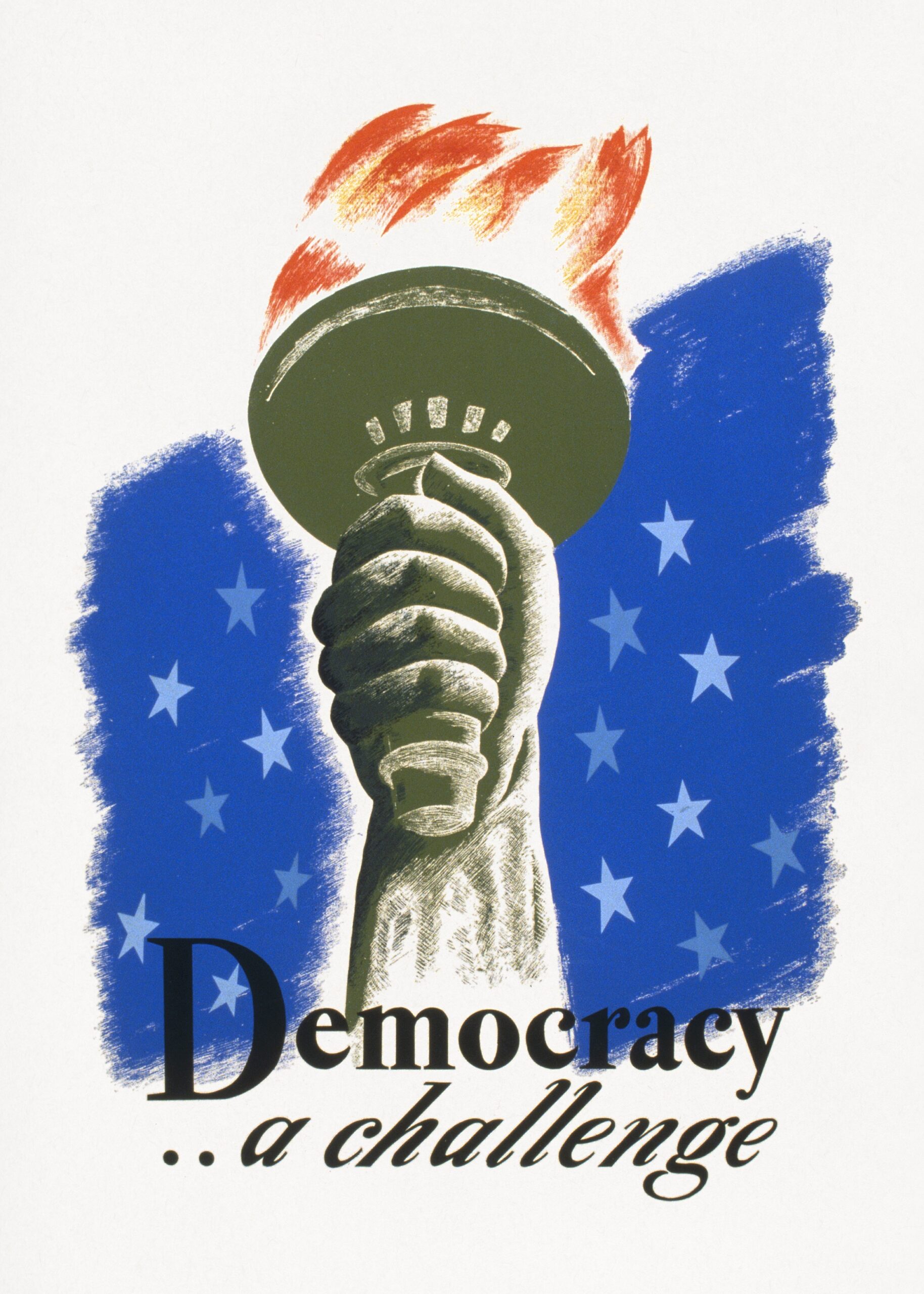
Against the backdrop of a failing war with Iran and fast-approaching U.S. midterm elections, with Trump’s approval ratings falling into record lows, we look at how democracy requires active civic participation to survive. We explore the variables that contribute to the erosion of democracy and the rise of political violence, while also highlighting those who are especially at risk during electoral periods. We also offer insights into what can be done to ensure that democracy persists and fascism does not take hold within our government and society. Here is the research we’ve been reading:
How “Ordinary People” Turn to Election Violence: The Role of Narratives and Social Infrastructure
How do “ordinary people” become involved in election violence?
Kathleen Klaus and Megan Turnball develop a framework for understanding what they call the joint production of election violence and explore how it helps us understand cases of election violence in Nigeria (2003) and the United States (2021):
- Their framework highlights two factors that make participating in election violence both thinkable and feasible for ordinary people: “narratives that legitimize and authorize violence” and a social infrastructure that helps organize violence.
- Narratives:
- Two types of narratives are most common in enabling election violence: threat narratives—where the way of life, safety, or status of a group is represented as under threat by another group or the state—and injustice and victimhood narratives—where a group is represented as having been wronged or neglected.
- Both types of narratives can legitimize violence, making it thinkable—either to defend against an impending or ongoing threat, or to right a wrong or take something back. Ordinary people participating in election violence are motivated therefore by the desire not just to win an election but more broadly to defend their way of life, protect their families, or fight for justice and recognition.
- These narratives can become even more powerful when political elites validate them, especially amid high-stakes moments like elections that can carry a manufactured sense of crisis.
- Social infrastructure:
- The social infrastructure that coordinates and facilitates election violence can be characterized by either direct organization (where politicians are more directly involved, even providing material and/or logistical support) or indirect organization (where “networked social movements” take on a more central role, providing logistical coordination but also common identity and purpose).
- U.S. case study (2021):
- In the U.S., both threat narratives (about a white/European, patriarchal culture being attacked or overtaken and a tyrannical government threatening individual freedom) and victimhood narratives (about mainly white, American men being left behind as a “liberal government” lets others—people of color, women, etc.—get ahead) were present to legitimize violence on January 6.
- The social infrastructure of the January 6 insurrection was characterized by indirect organization and included three main dimensions: online networks that brought participants together from around the country, creating a common vision and identity and facilitating logistics; militia groups who provided ideological and material support, militia training, and on-site direction to the crowd; and President Trump’s messaging, which “amplif[ied] narratives of threat and victimhood” and inspired, coordinated, and encouraged rioters.
- The joint production of election violence requires both that people understand their violence as legitimate and that they be connected to a larger organizational structure that provides not only the coordination and support necessary to make collective violence possible but also group identities that help further motivate participation.
| Joint production of election violence: | “the process through which political elites and ordinary citizens come together to produce election-related violence.” |
| Social infrastructure that coordinates and facilitates election violence: | “the organizational structures and networks that connect politicians with potential perpetrators of violence, or potential perpetrators with one another.” |
Citation: Klaus, K., & Turnball, M. (2025). Democracy dismissed: When leaders and citizens choose election violence. Journal of Peace Research, 62(5), 1447-1462.
Anti-Immigrant Attitudes during Election Season
How does intensified anti-immigrant rhetoric often adopted by right-wing parties during elections affect public attitudes towards immigration?
Miguel Carreras, Sofia Vera, and Giancarlo Visconti draw on public survey data (2016-2021) from 45 democracies (including the U.S.) to see if people’s attitudes towards immigration are influenced by recent elections:
- Right-wing political parties tend to gain politically in elections from focusing on immigration and casting it in a negative light to galvanize supporters. Despite disagreeing with this framing, left-wing parties tend to avoid discussing immigration, as the issue is seen to be “owned” by right-wing parties and therefore not advantageous for left-wing parties to raise, resulting in the overall prominence of anti-immigrant narratives during elections.
- The public has greater exposure to negative messages on immigration during elections—that frame immigration as an “economic, cultural, and security problem”—leading the authors to hypothesize that public attitudes on immigration will likely be most negative around elections.
- Among the public as a whole, the authors find no significant variation in attitudes about immigration from election day to 90 days after an election.
- When the authors look specifically at different ideological groups, they do find significant variation in attitudes over time, with these groups having “sharply polarized views on immigration around election time” that “grow more similar as time elapses”:
- Right-wing respondents have more negative attitudes on immigration immediately after an election, with these getting less negative over time.
- Left-wing respondents have more positive attitudes on immigration immediately after an election, with these getting less positive over time.
- While it makes sense that right-wing voters should have heightened negative attitudes about immigration during election season, it is puzzling that left-wing voters should have heightened positive attitudes around election time—even though they are also surrounded by right-wing, anti-immigrant messaging. This finding may be explained either by the hardening of ideological identities during elections, or by the left-wing media filter through which these voters hear right-wing messaging on immigration, which ends up strengthening their more positive views on immigration.
- Although any heightened polarization of attitudes on immigration around election time seems to be short-lived, elections are likely more dangerous times for immigrants who may be threatened by violence related to the negative, dehumanizing, anti-immigrant attitudes that are at their height then.
Citation: Carreras, M., Vera, S., & Visconti, G. (2025). Democratic elections and anti-immigration attitudes. Journal of Peace Research, 62(5), 1498-1513.
Threats of Violence to Politicians and the Dangers to Democracy
When violence against politicians becomes salient, do politicians become more authoritarian in their views?
- Exposure to political violence, even as a reminder rather than a direct experience, pushes elected officials toward authoritarian thinking, preferring control and hierarchy over democratic participation.
- The shift is driven less by fear and more by disgust: when politicians think about violence against their peers, they most often reach for words like “corruption,” “bad,” and “sad,” not “scared” or “threatened.” They read violence as a sign that the whole system is broken and authoritarian governance as the fix.
- Opposition party politicians in the South African context are the most vulnerable to this shift. Because they already view the ruling party’s governance as corrupt, political violence confirms that narrative and makes drastic, order-restoring measures feel justified, even at the cost of democratic rights.
- Ruling party politicians show almost no shift. They interpret the same violence as the work of individual bad actors, not as a reflection of systemic failure, which protects their support for the existing democratic system but also allows them to minimize a serious problem.
- This study identifies a pathway from political violence to democratic erosion that runs through elected officials themselves: violence makes politicians less committed to democratic values, which makes it less likely they will push back when those values are violated by others.
- Political violence not only harms its direct victims. It shapes how elected representatives think about democracy itself.
Citation: Lockwood, S., & Martin, P. (2026). Living in Fear? Political Violence and Authoritarian Attitudes Among Politicians in South Africa. Journal of Conflict Resolution, 70(2-3), 387-413.
Inequality, Polarization, and the Death of Democracy
How does income inequality contribute to democratic erosion, even within longstanding democracies such as the United States?
Drawing on a dataset of over 100 countries from 1999 to the 2020s, Eli Rau and Susan Stokes used statistical analysis to investigate the relationship between economic inequality and democratic erosion and found that inequality is one of the clearest indicators of where and when democracy declines.
- Historically, democratic erosion often took place through military coups, while more recent instances of democratic erosion have typically been driven by elected leaders.
- Wealthy and longstanding democracies are not immune to democratic backsliding, although they exhibit partial resiliency due to possessing robust political institutions, as well as more resources to manage social friction.
- Wealth inequality fuels political polarization, which leads to populist leaders who undermine democratic institutions and norms to consolidate power, creating a shift toward fascism.
- High inequality leads to public cynicism and the loss of confidence in the systems of government, which are seen to serve the elite few, rather than the broader public.
- The alienation felt by the public, due to inequality, is leveraged by populist leaders who proceed to campaign as “anti-elite” outsiders, with promises to fight a corrupt status quo for the benefit of the neglected majority.
Citation: Rau, E. G., & Stokes, S. (2025). Income inequality and the erosion of democracy in the twenty-first century, Proceedings of the National Academy of Sciences of the United States of America. 122 (1), https://doi.org/10.1073/pnas.2422543121.
Energy Democracy in the European Union for a Just Transition
How does the European Commission represent communities and their role in energy transition in the European Green Deal and related strategic documents on energy?
Emily K. Gray and Rachel McArdle performed a qualitative content analysis of four strategic energy policy documents within the European Green Deal to evaluate how the European Commission conceptualizes the role of communities in the energy transition.
- The European Green Deal (EGD) “is the European Union’s (EU) flagship policy to make Europe the first climate neutral continent,” however, it is “primarily interested in top-down, technocratic governance and market-based solutions” to the energy transition.
- Energy democracy embraces the idea that “people are affected by energy and should therefore be involved in the decision-making around it.” Communities (as opposed to individual experts or energy consumers) play an important role in facilitating energy democracy as “participants, changemakers, and [the] locus of [energy] system transformation.”
- Given that energy policy is “a key area for democratic experimentation and innovation,” the authors analyze and are concerned about how community involvement is envisioned and planned for in the EGD.
- After analyzing language and engagement mechanisms in the EGD, the authors find that it “falls short of the deliberative democratic governance needed for transformational change.”
- Community participation with the EGD is outlined through formal groups and processes within the EU. These are “formal, economic, and technical” in nature and “do not provide significant spaces for communities of varying types to address the energy transition in diverse ways, in accordance with the full range of [participation], social practices, and situated or experiential knowledges and expertise.”
- Energy communities are central to how the EGD envisions community participation, but they “are defined in terms of alleviating energy poverty,” and “there is little consideration of [the] political or social elements and dynamics [of energy communities], or their potential for transformational change.”
- While rewriting the green deal is unlikely, the EU can advocate for the inclusion of various communities in decision-making, as “deeper engagement…will not only contribute to energy transitions, reducing conflict, but will also help achieve energy democracy through ensuring multiple actors are included in future strategies.”
| Energy democracy: | “an ongoing process…by which individuals and collectives constantly engage” in deliberative democratic decision-making on energy systems. |
| Energy communities: |
a specific term used in the EU that “refers to collective participation in the energy sector” and, more specifically, to a “type of community of interest, …often but not always involved in shared production and consumption of energy, …typically connected to residents and renewable energy sources.” They aim for “transformed, distributed, locally-owned energy systems.” |
| Deliberative democracy: |
“[A] system in which people discuss before they make decisions.” Levine, P. (2022, January 26). Deliberative democracy: Civic theory and practice. Retrieved May 28, 2026, from https://sites.tufts.edu/civicstudies/2022/01/26/deliberative-democracy/ |
Citation: Gray, E. K., & McArdle, R. (2025). Communities and the European Green Deal: Opening ‘sites of struggle’ for a democratic energy transition. Journal of European Integration, 47(2), 193–215. https://doi.org/10.1080/07036337.2025.2455683
Informing Practice
Democracy requires the active and continuous participation of civil society and elected officials to be protected from authoritarianism and fascism. Longstanding democracies, including the U.S., are not immune from democratic backsliding (Rau & Stokes), as can be observed in the unaccountable use of security forces for political purposes, the politicization of the Department of Justice, disregard for and dismantling of congressionally mandated institutions, targeting of dissent, and other activities of the current Trump administration over the past year and a half. Polarization harms democracy and serves as an amplifier of political violence. Anxiety over an increasing likelihood of political violence due to rampant political polarization and dehumanizing rhetoric is not an abstract concern. It is worth noting that such rhetoric—especially top-down xenophobic, anti-immigrant rhetoric used to galvanize support for primarily right-leaning parties (Carreras et al.)—intensifies during election periods. The political context we are navigating within the United States includes an ever-increasing surveillance and policing infrastructure primarily targeting immigrant and BIPOC communities, threatened, attempted, and actual violence against elected officials and other public figures, and the memory of the January 6th Capitol insurrection to try to reverse the outcome of the 2020 election, with the Trump administration rewarding rather than reprimanding the participants. Evidently, the erosion of democracy does not happen in a vacuum. It is driven by factors like wealth inequality, identity politics (“us vs. them” and victimhood narratives), and a negative feedback loop of violence and disorder.
Wealth inequality fuels political polarization and grievance (Rau & Stokes) and makes people more susceptible to victimhood narratives and the projection of systemic failure onto the The recent ICE crackdown in Minnesota, which also led to the murders of Alex Pretti and Renee Good, happened in the context of a right-wing campaign accusing the Somali community of fraud that went viral on social media before making its way to the top chambers of government, highlighting the mutually reinforcing web of horizontal and vertical strands of xenophobic rhetoric in this country. The hardening of political identities is most accentuated during electoral periods, when the public is exposed to a greater degree of political messaging on divisive topics such as immigration (Carreras et al.). Additionally, left-leaning and moderate candidates tend to downplay the topic of borders and immigration, effectively ceding the discursive space to the right (Carreras et al.). This makes for election periods that are acutely dangerous for minority communities who are often fodder for xenophobic rhetoric employed by far-right politicians. In these narratives, valid grievances such as rising costs of living are attributed to neither systemic failures nor political mismanagement nor corruption, but rather to immigrant communities, who are framed by right-wing politicians and.
These combined threat and victimhood narratives foster an environment that makes political violence thinkable, while the social infrastructure such as online forums, networks, and militia groups then makes political violence possible (Klaus & Turnball), along with easy access to firearms. In addition, exposure to and reminders of political violence can shift politicians toward authoritarian values, such as favoring order over citizen input, punishing protest and dissent, and deferring to party leaders over constituents (Lockwood & Martin). Many political scientists believe that the United States has been rapidly shifting toward authoritarianism—with benchmark surveys like Bright Line Watch used to monitor democratic practices, their robustness, and potential threats—pointing toward the erosion of democracy. This democratic erosion is taking place within the of increasing political violence in the U.S., from an increase in political assassinations and assassination attempts (such as the murder of Minnesota House Speaker, Melissa Hortman, and the attempted assassination of President Trump) to white-supremacist activity and terrorist attacks (such as at the Islamic Center of San Diego) to ICE impunity as it uses state-sanctioned violence against immigrant communities and protesters all across the United States—with a whopping budget of $85 billon at its disposal, made possible through the One Big Beautiful Bill Act.
Participating in democracy is more crucial than ever. Traditionally, U.S.-based campaigns, movements, or non-profits concerned with strengthening democracy, on the one hand, and preventing political violence, on the other, have worked in isolation from each other. In addition, much of the focus of U.S.-based democracy and peacebuilding NGOs has been directed outward into the international domain rather than inward to the domestic context. This moment demands the merging of peacebuilding and pro-democracy sectors in a united front, as protecting U.S. elections requires democracy work, while deescalating violence and building community resilience against polarization both require peacebuilding expertise.
Furthermore, silence is a losing strategy. Left-leaning and moderate politicians and public figures need to assertively counter the negative myths, stereotypes, and dehumanizing rhetoric that fuel anti-immigrant sentiment, crafting a bold, new narrative that highlights the positive contributions of immigrants to the American economic, social, and cultural landscape and that proclaims the alignment between welcoming immigrants and American values and principles. Rather than be reactive and defensive, political leaders can be proactive, nimble, and unabashed in their political messaging and efforts on immigration.
Finally, deliberative democracy can serve as the antidote to democratic backsliding and rising authoritarianism, embracing hope instead (Gray & McArdle). Top-down democratic processes can feel exclusionary, especially when factors such as inequality foster cynicism and a loss of confidence in government systems (Rau & Stokes). Local grassroots efforts can serve as the anthesis to elitest political processes, rekindling democratic norms through individual and collective agency. There are opportunities to revive democratic norms by thinking creatively about a range of issues that affect our daily lives. For instance, although energy policy is often considered a top-down, technocratic arena, the fact that it shapes critical aspects of daily life means that there should be a role for communities as active participants in the policy-making process (Gray & McArdle). Growing opposition to the construction of data centers has become a hot-button issue around the U.S.—and one that promisingly cuts across the partisan divide. Whether the opposition is grounded in concerns about environmental pollution or skyrocketing energy costs, the data center issue brings forward questions on how natural resources are used and who is valued in these decision-making processes. Replacing a “traditional approach” to energy policy with energy democracy could shift the mindset of civil society from being passive “victims of the system” to being active participants in democracy, with the agency to shape an alternate future worth struggling for.
Photo credit: rawpixel